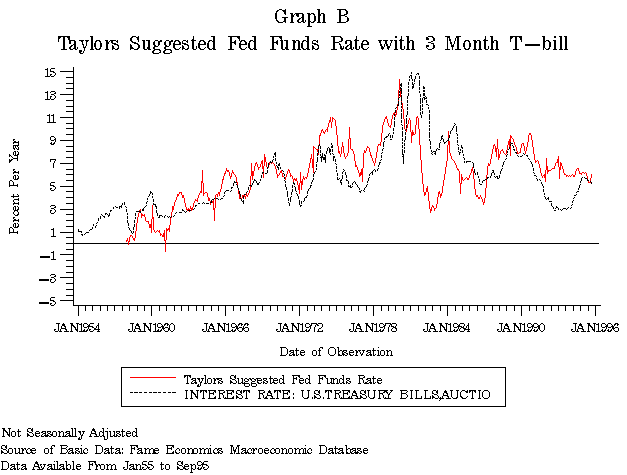
Taylors suggested FED funds rate is calculated as;
ta = p1 + p2 + p3 + p4
where
p1 = neutral real short-term interest rate
p2 = inflation rate
p3 = .5*p2 if p2<1 else .5
p4 = .5*(growth rate in real gdp - long run growth rate in real gdp)
E. Minutes of the Federal
Open Market Committee
The actions of the Federal Reserve's Open Market Committee (i.e. buying
and selling government securities) are very important in determining the
future direction of the economy. The FOMC meets every six weeks in
Washington, DC at the Federal Reserve Board (FRB).
The minutes of the meeting are published on the web at the FRB homepage.
When was the last meeting meeting of the FOMC? Is the FED moving to push
interest rates higher, lower, or holding them constant? Obviously raising
interest rates represents a tightening of monetary policy and implies a
slower economy over the next six months to a year. In contrast, lowering
interest rates represents a loosening of monetary policy and implies a
faster-paced economy over the next six months to a year. Note that the
FRB releases the minutes of the FOMC with a delay so, if you want a more
current commentary on what the FOMC might be contemplating doing about
monetary policy, you should consult recent issues of the WALL STREET
JOURNAL, INVESTORS BUSINESS DAILY, or the like.
F. The Beige Book Report on the
12 Federal Reserve Districts' Reginal Economies
Shortly after each meeting of the Federal Open Market Committee the Federal
Reserve Board releases a so-called Beige book report on the economic
health of the regional economies of the 12 Federal Reserve Districts.
The Beige Book is published on the web at the FRB homepage.
How is our regional economy doing? See the latest report on the 11th
Federal Reserve District (Texas and parts of Louisiana and New Mexico).
Previous Menu