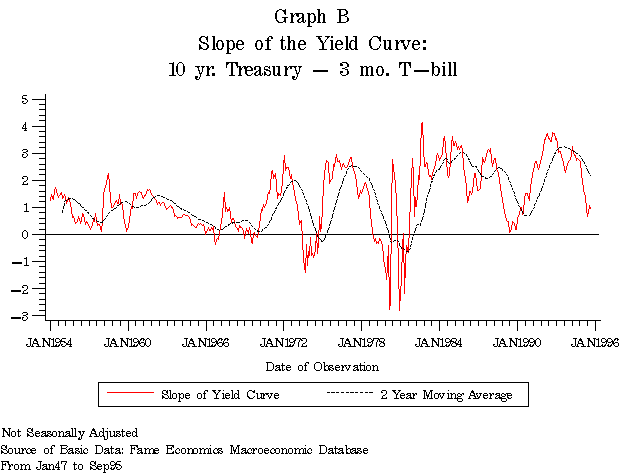
Note: The slope of the yield curve (difference in interest rates
between a 10 year Treasury note and a three month Treasury bill) often
signals future strength or weakness in the economy. If the slope of the
yield curve increases, the economy is likely to strengthen somewhat in
the next six months to a year. If the slope of the yield curve decreases
and, in particular if the slope of the yield curve becomes negative (i.e.
the three month T-bill rate is greater than the 10 year Treasury note rate),
the economy is likely to weaken somewhat in the next six months to a
year. The logic is as follows. When the economy is slack yet
ready to grow, short-term interest rates are likely to be relatively
low. In contrast when the economic expansion is mature and
"ready" for a slowdown, short-term interest rates are likely to be
relatively high due to intensive demand for loanable funds at the top of
the business cycle.
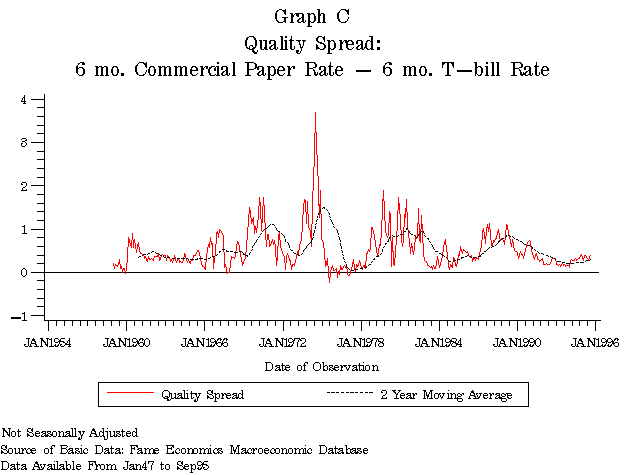
Note: The quality spread often signals future strength or
weakness in the economy. If the quality spread increases, the economy is
likely to weaken somewhat in the next six months to a year. If the
quality spread decreases, the economy is likely to strengthen somewhat in
the next six months to a year. An increasing quality spread results from
lenders demanding relatively higher interest rates from corporate
borrowers probably because lenders view future repayment to be at greater
risk due to possible future weakening of the economy. The opposite
reasoning applies to a declining quality spread.
E. Average Durations of Recessions
and Expansions since 1945
The peaks and troughs of the business cycles of the U.S. economy are
determined by the Business Cycle Dating Committee of The National Bureau of Economic Research
(NBER). The following information on the peak and trough dates of
the U.S. economy since 1945 was obtained from the NBER web site which you
can click on above. From these dates the durations of the recessions and
expansions since 1945 can be computed and analyzed.
NBER Official Business Cycle Dates and Durations
1945 - Present
Recessions
(peak to trough) | Duration
in
Months | Expansions
(trough
to peak) | Duration
in Months |
| Feb45-Oct45 | 8 | Oct45-Nov48 | 37 |
| Nov48-Oct49 | 11 | Oct49-Jul53 | 45 |
| Jul53-May54 | 10 | May54-Aug57 | 39 |
| Aug57-Apr58 | 8 | Apr58-Apr60 | 24 |
| Apr60-Feb61 | 10 | Feb61-Dec69 | 106 |
| Dec69-Nov70 | 11 | Nov70-Nov73 | 36 |
| Nov73-Mar75 | 16 | Mar75-Jan80 | 58 |
| Jan80-Jul80 | 6 | Jul80-Jul81 | 12 |
| Jul81-Nov82 | 16 | Nov82-Jul90 | 92 |
| Jul90-Mar91 | 8 | | |
| | | |
| Mean | 10.4 months | | 49.89 months |
Standard
Dev. | 3.34 months | | 30.81
months |
| Skewness | 0.838
(skewed
right) | | 0.955
(skewed right) |
Excess
Kurtosis | -0.0573 | | 0.080 |
| | | |
| Quantiles | | | |
| 100% max | 16 | 100% max | 106 |
| 75% Q3 | 11 | 75% Q3 | 58 |
| 50% med | 10 | 50% med | 39 |
| 25% Q1 | 8 | 25% Q1 | 36 |
| 0% min | 6 | 0% min | 12 |
| | | |
Number of
Recessions | = 10 | Number
of
Expansions | = 9 |
The average duration of a Recession since 1945 (there has been 10 of
them) is 10.4 months with a standard deviation of 3.34 months. In
contrast (thank goodness), the average duration of an expansion since
1945 (there have been 9 of them) is 49.89 months with, alas, a standard
deviation of 30.81. The upshot of these statistics is that there is more
certainty in the timing of a recovery (i.e. reaching a through) than in the
timing of a recession (i.e. reaching a peak). The distributions of both
recessions and expansion durations are skewed to the right (i.e. have
long right-hand tails). The quantiles for the distributions of both
durations are also reported in the above table.
Some economists believe there is a "mortality" aspect associated with
business cycles. That is, for example, the longer we are in an
expansion, the greater the probability it will soon end. See, for
example:
- S.N. Neftci (1982), "Optimal Prediction of Cyclical Downturns,"
Journal of Economic Dynamics and Control, 4, 225-41.
For a more recent view on duration dependence in the business cycles see:
- Diebold, Francis X. and Glenn D. Rudebusch (1991), "Turing Point
Prediction with the composite Leading Index: An Ex Ante Analysis,"
Chapter 14 in LEADING ECONOMIC INDICATORS: NEW APPROACHES AND FORECASTING
RECORDS, eds. K. Lahiri and G.H. Moore, Cambridge: Cambridge University
Press, 1991, page 231-256.
Diebold and Rudebusch conclude that "Overall, postwar expansions and
contractions show only weak, if any, duration dependence." (p. 246).
Previous Menu